Contain in seconds, never by accident.
Every action is requested, approved by a second person (or a standing policy you wrote), signed with Ed25519 and verified by the agent before it touches the host.
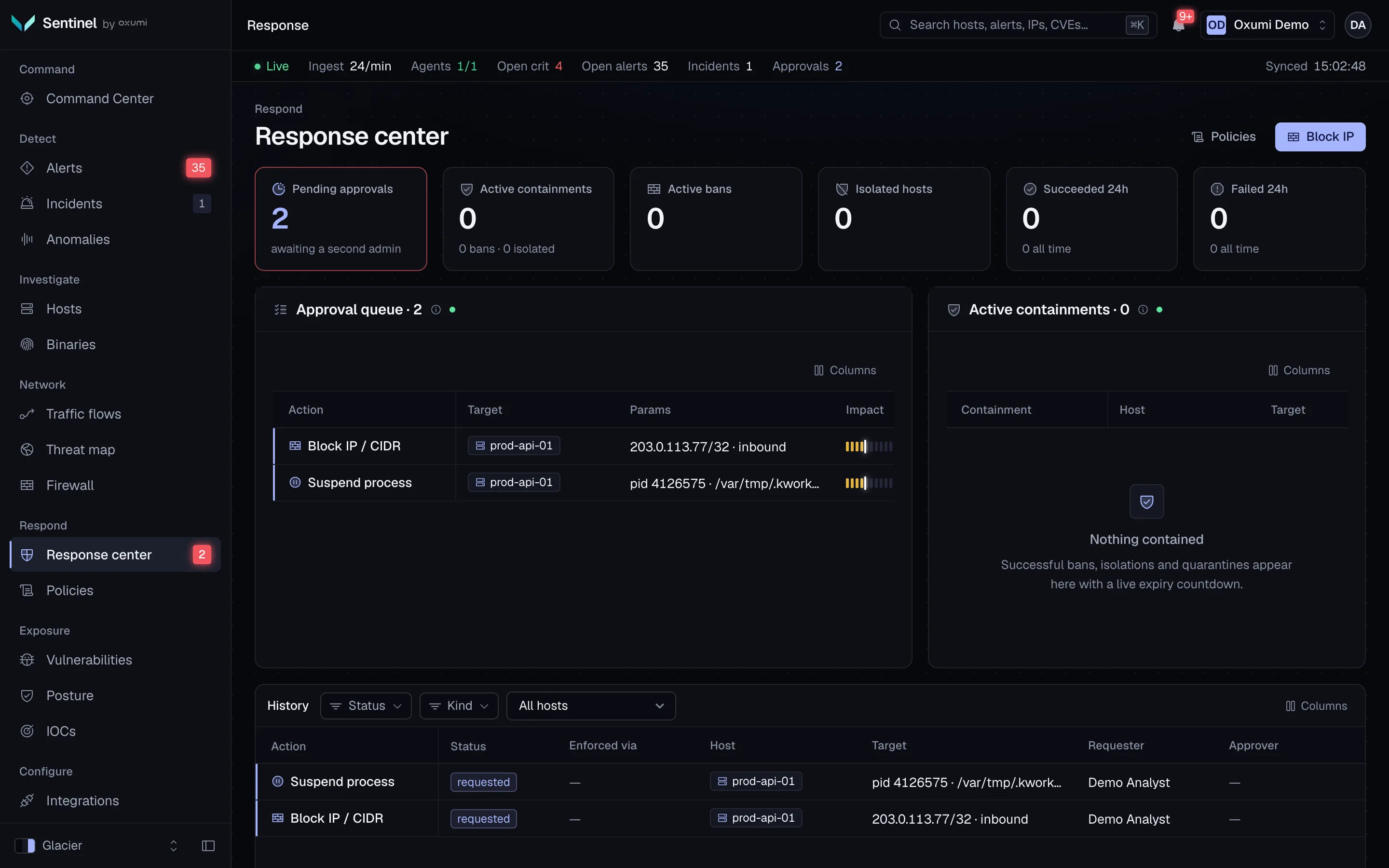
Eight actions, each with a way back.
Reversible actions record their inverse, so a rollback is one approved click.
Processes
Suspend process↺ Resume
SIGSTOP freezes it without losing memory.
Capture process image
Copies /proc/<pid>/exe into evidence before anything else changes.
Kill process
Terminates the exact (pid, start time) pair, never a reused pid.
Network
Block IP↺ Unblock
Adds the remote to Sentinel's own nftables set, with an expiry.
Isolate host↺ Release
Drops all traffic except the control plane and an admin allowlist.
Files & users
Quarantine file↺ Restore
Moves the on-disk binary out of reach and records its hash.
Disable user↺ Enable
Locks the account and its SSH keys.
Revoke agent
Retires a host's identity so it can no longer report or act.
Signed, short-lived, host-bound.
- 01
Requested
Someone names the action, the target and why. - 02
Approved
A second person approves, or a standing response policy you wrote does. Both are audited. - 03
Signed
The control plane signs the command with its Ed25519 key, with an expiry and the target host id. - 04
Verified on the host
The agent checks signature, expiry and host, and only acts within its capability profile.
$ nft list table inet oxumi_sentinelSimplifiedtable inet oxumi_sentinel {chain output {type filter hook output priority -10; policy accept;ip daddr 10.0.0.10 tcp dport 443 accept # control plane, always firstip daddr 198.51.100.23 counter log prefix "OXUMI-DROP r-91c2 " dropip daddr 203.0.113.41 counter log prefix "OXUMI-DROP r-91c3 " drop}chain input {type filter hook input priority -10; policy accept;ip saddr 203.0.113.77 counter log prefix "OXUMI-DROP ban-7f " drop}}
A firewall you can see.
Sentinel keeps to its own nftables table, so it never edits your rules. SSH brute force can be banned automatically with an escalating ladder, and threat-feed addresses can be blocked fleet-wide.
- 10mactive
- 1h—
- 24h—
- 7d—
Example
Isolation with a dead-man rollback.
Isolating a host keeps the control plane reachable. If the agent loses the control plane after isolating, it rolls the isolation back on its own, so a mistake can't strand the host.
Containment is an opt-in capability profile; the default agent is read-only.
- Host isolated · only loopback, established, DNS, the control plane and your allowlist
- Control plane unreachable · dead-man timer starts
- Waiting 15 min · SENTINEL_ISOLATION_DEADMAN
- Isolation rolled back · deny rules stay; rollback recorded
- Reconnected · agent reports deadman.rolledBackAt and re-applies what the server wants
Put a sentinel on every Linux server.
One command to install, one dashboard to monitor, one workspace to understand what happened across your fleet.