Detection that runs on the host.
Six collectors feed a local rule engine with 41 ATT&CK-mapped rules, binary analysis, IOC matching and learned baselines. Detections fire even when the control plane is unreachable.
Six collectors, one small agent.
A static Go binary in a read-only container. It reads the host through read-only mounts and never opens a port.
Processes
Every start and exit with exe, argv, parent chain, user and image hash. memfd, deleted and hidden-path images are flagged on sight.Network
Connections and listeners attributed to the owning process, including inside container network namespaces.Authentication
SSH and sudo activity from the auth log: brute force, new keys, unusual logins.Persistence
Cron, systemd units, shell profiles, authorized_keys and ld.so.preload, diffed against what was there before.File integrity
Critical paths hashed and watched; staged executables in /tmp, /var/tmp and /dev/shm are scanned.Binary analysis
YARA-lite string and section heuristics on suspicious executables, plus your own IOC lists.
41 rules across 24 techniques, published.
Generated from the agent's own builtin.yaml, so this page can't claim more than ships. Gaps stay visible.
- Reconnaissance— no built-in agent rule yet
- Resource Development— no built-in agent rule yet
- Initial Access2
- Execution2
- Persistence8
- Privilege Escalation1
- Defense Evasion10
- Credential Access2
- Discovery— no built-in agent rule yet
- Lateral Movement— no built-in agent rule yet
- Collection— no built-in agent rule yet
- Command and Control12
- Exfiltration— no built-in agent rule yet
- Impact4
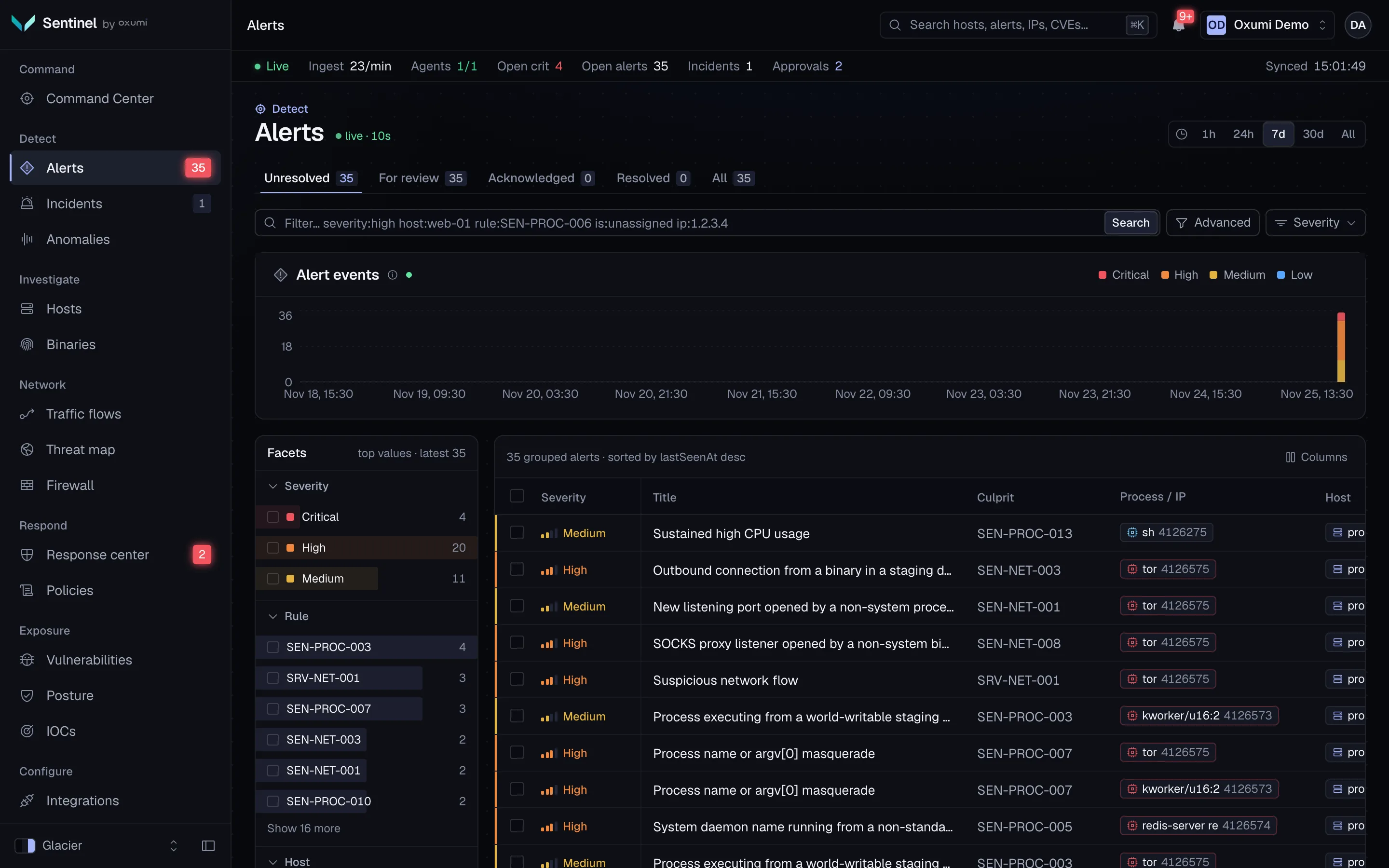
- SEN-PROC-001Process running from a deleted binaryThe executable backing this process has been removed from disk and nothing has replaced it. Droppers commonly execute a payload and delete it to hinder forensics. memfd images always show as deleted and are reported here as well as by SEN-PROC-002.HighT1070.004(opens MITRE ATT&CK)
- SEN-PROC-002Fileless execution from memfdProcess executes from an anonymous memory file (memfd), a common fileless-malware technique.HighT1620(opens MITRE ATT&CK)
- SEN-PROC-003Process executing from a world-writable staging directoryBinary runs from /tmp, /var/tmp or /dev/shm, where downloaded payloads are typically staged.MediumT1105(opens MITRE ATT&CK)
- SEN-PROC-004Userland process masquerading as a kernel threadProcess name mimics a kernel thread (kworker, ksoftirqd, ...) but has a userland executable.HighT1036.004(opens MITRE ATT&CK)
- SEN-PROC-005System daemon name running from a non-standard pathA process uses the name of a well-known system daemon but its executable lives outside the system binary directories.HighT1036.005(opens MITRE ATT&CK)
- SEN-PROC-006Reverse shell command lineCommand line matches a known reverse/bind shell construction.HighT1059.004(opens MITRE ATT&CK)
- SEN-NET-001New listening port opened by a non-system processA TCP listener appeared whose owning executable lives outside the system binary directories (possible bind shell or rogue service).MediumT1571(opens MITRE ATT&CK)
- SEN-AUTH-001SSH brute forceMany failed SSH authentications from a single source address in a short window.MediumT1110.001(opens MITRE ATT&CK)
- SEN-AUTH-002Successful login after repeated failures from the same sourceA source address that just failed several logins authenticated successfully (possible successful brute force or password spray).HighT1110(opens MITRE ATT&CK)
- SEN-AUTH-003Privilege elevation by a user not seen beforeA user ran sudo or su successfully for the first time on this host (after the learning period).MediumT1548.003(opens MITRE ATT&CK)
- SEN-AUTH-004Account added to a privileged groupA user was added to a group granting root-equivalent access (sudo, wheel, docker, ...).MediumT1098(opens MITRE ATT&CK)
- SEN-PERS-001New SSH authorized keyAn SSH authorized_keys file was created or gained new entries.HighT1098.004(opens MITRE ATT&CK)
- SEN-PERS-002New systemd unitA new systemd unit file or enablement symlink was created.MediumT1543.002(opens MITRE ATT&CK)
- SEN-PERS-003New or modified cron jobA cron file was created, or an existing one gained new lines.MediumT1053.003(opens MITRE ATT&CK)
- SEN-PERS-004Dynamic linker preload configured/etc/ld.so.preload was created or modified; every dynamically linked program will load the listed libraries (rootkit technique).HighT1574.006(opens MITRE ATT&CK)
- SEN-NET-002Shell or netcat with a connection to a public IPA shell (sh, bash, dash, zsh, ...) or a netcat/socat process holds an established TCP connection to a public address: the typical shape of a reverse or bind shell.HighT1059.004(opens MITRE ATT&CK)
- SEN-NET-003Outbound connection from a binary in a staging directoryA process whose executable lives in /tmp, /var/tmp, /dev/shm or an anonymous memfd opened an outbound connection (download-and-execute payloads, implants, droppers).HighT1105(opens MITRE ATT&CK)
- SEN-NET-004Connection to a cryptocurrency mining pool portOutbound connection to a port commonly used by Stratum mining pools (3333, 4444, 5555, 7777, 14444, 45700). Loopback connections are ignored.HighT1496(opens MITRE ATT&CK)
- SEN-PROC-012Cryptocurrency miner processProcess name or command line matches a known miner (XMRig, minerd, cpuminer, ...) or a Stratum pool URL.HighT1496(opens MITRE ATT&CK)
- SEN-NET-005Tor network connectionConnection to a Tor relay port (9001, public) or to a local Tor SOCKS proxy (9050/9150, any address), used to hide command-and-control traffic.MediumT1090.003(opens MITRE ATT&CK)
- SEN-NET-006Shell or interpreter listening on all interfacesA shell, script interpreter or netcat opened a new TCP listener on 0.0.0.0 or :: (bind shell, ad-hoc file server). node and java are excluded: long-running application servers legitimately listen on all interfaces.MediumT1571(opens MITRE ATT&CK)
- SEN-PROC-013Sustained high CPU usageA process used more than 90% of a CPU for at least two minutes (8 consecutive 15-second process.top samples). Common cause on servers: cryptomining. Compilers, compressors, media encoders and package managers are allowlisted.MediumT1496(opens MITRE ATT&CK)
- SEN-NET-007Web server child connecting out on a non-web portA process spawned by a web server (nginx, apache2, httpd, PHP-FPM, node, java) opened an outbound connection to a public address on a port other than 80/443: typical of a web shell or exploited application calling back.HighT1190(opens MITRE ATT&CK)
- SEN-PROC-007Process name or argv[0] masqueradeargv[0] or the process name looks like a kernel thread (kworker, ksoftirqd, ...) or a system daemon (sshd, redis-server, ...), but the executable is something else.HighT1036.005(opens MITRE ATT&CK)
- SEN-PROC-008Executable inside a hidden directoryThe executable lives in a dot-directory under /tmp, /var/tmp, /dev/shm or a home directory (well-known tool dirs such as ~/.local, ~/.cargo, ~/.nvm are excluded).HighT1564.001(opens MITRE ATT&CK)
- SEN-PROC-009Orphaned user process running from tmp, shm or memfdA non-root process re-parented to init (PPID 1) runs from /tmp, /var/tmp, /dev/shm or an anonymous memfd: the parent exited to detach it (daemonized implant).HighT1036(opens MITRE ATT&CK)
- SEN-PROC-010Web/app runtime spawned an unexpected binaryA suspicious process carries a PM2 / npm application environment but its executable is neither in the application directory nor a node runtime: an exploited app (e.g. a Next.js RCE) launched a payload.CriticalT1190(opens MITRE ATT&CK)
- SEN-PROC-011Suspicious process spawned Tor, a miner or a downloaderA process whose parent runs from tmp/shm/memfd or a deleted binary spawned Tor, a cryptominer or a downloader (cURL, Wget, ...): an implant staging its next stage.CriticalT1105(opens MITRE ATT&CK)
- SEN-NET-008SOCKS proxy listener opened by a non-system binaryA listener on a Tor/SOCKS port (9050, 9150, 9151) owned by an executable outside the system directories: an embedded Tor client used for hidden C2.HighT1090.003(opens MITRE ATT&CK)
- SEN-NET-009Connection attempts to public IPs from a suspicious executableA process running from tmp/shm/memfd or a hidden directory has connections stuck in SYN_SENT to public addresses: failed command-and-control or relay attempts.HighT1071(opens MITRE ATT&CK)
- SEN-FILE-001Executable staged in a temporary directoryAn ELF or script with an exec bit, a hidden name or in a hidden directory appeared under /tmp, /var/tmp or /dev/shm.MediumT1105(opens MITRE ATT&CK)
- SEN-PERS-005Cron reboot entryA cron file gained an at-reboot line, which runs a command at every boot (implant persistence).HighT1053.003(opens MITRE ATT&CK)
- SEN-PERS-006SSH login script (ssh rc) created or modified~/.ssh/rc or /etc/ssh/sshrc runs on every SSH login; implants use it to re-launch themselves.HighT1546.004(opens MITRE ATT&CK)
- SEN-BIN-001Botnet command vocabulary in executableBotnet / DDoS C2 command words (attack, stopattack, cveprobe, sniff, autossh, reinstall, bang-prefixed).CriticalT1219(opens MITRE ATT&CK)
- SEN-BIN-002Cryptominer strings in executableStratum pool URLs, XMRig, RandomX or donation-level options.HighT1496(opens MITRE ATT&CK)
- SEN-BIN-003Downloader with multiple fetch fallbacksThe binary references four or more download tools (cURL, Wget, BusyBox, Python, PHP), typical dropper fallbacks.MediumT1105(opens MITRE ATT&CK)
- SEN-BIN-004Executable writes reboot cron entriesThe binary writes at-reboot cron entries (self-installing persistence).HighT1053.003(opens MITRE ATT&CK)
- SEN-BIN-005In-memory (memfd) loaderThe binary creates anonymous memory files and executes them via proc fd paths (fileless loader).MediumT1620(opens MITRE ATT&CK)
- SEN-BIN-006Embedded Tor configurationThe binary contains Tor configuration directives (SOCKS port with client-only or data-directory options).HighT1090.003(opens MITRE ATT&CK)
- SEN-BIN-007Packed executable (UPX)UPX packer markers in a suspicious executable.MediumT1027.002(opens MITRE ATT&CK)
- SEN-PROC-014memfd executable masquerading as container runtimeA process runs from a memfd named like runc/crun, but not in the shape of a legitimate runtime re-exec (comm/argv[0] runc or crun, parent a container manager such as containerd-shim, dockerd, buildkitd, podman or conmon).HighT1036.005(opens MITRE ATT&CK)
Every built-in rule, by tactic.
Open a tactic to see its rules, severity and ATT&CK technique.
Initial Access2Show rules
- SEN-NET-007Web server child connecting out on a non-web portHigh
- SEN-PROC-010Web/app runtime spawned an unexpected binaryCritical
Execution2Show rules
- SEN-PROC-006Reverse shell command lineHigh
- SEN-NET-002Shell or netcat with a connection to a public IPHigh
Persistence8Show rules
- SEN-AUTH-004Account added to a privileged groupMedium
- SEN-PERS-001New SSH authorized keyHigh
- SEN-PERS-002New systemd unitMedium
- SEN-PERS-003New or modified cron jobMedium
- SEN-PERS-004Dynamic linker preload configuredHigh
- SEN-PERS-005Cron reboot entryHigh
- SEN-PERS-006SSH login script (ssh rc) created or modifiedHigh
- SEN-BIN-004Executable writes reboot cron entriesHigh
Privilege Escalation1Show rules
- SEN-AUTH-003Privilege elevation by a user not seen beforeMedium
Defense Evasion10Show rules
- SEN-PROC-001Process running from a deleted binaryHigh
- SEN-PROC-002Fileless execution from memfdHigh
- SEN-PROC-004Userland process masquerading as a kernel threadHigh
- SEN-PROC-005System daemon name running from a non-standard pathHigh
- SEN-PROC-007Process name or argv[0] masqueradeHigh
- SEN-PROC-008Executable inside a hidden directoryHigh
- SEN-PROC-009Orphaned user process running from tmp, shm or memfdHigh
- SEN-BIN-005In-memory (memfd) loaderMedium
- SEN-BIN-007Packed executable (UPX)Medium
- SEN-PROC-014memfd executable masquerading as container runtimeHigh
Credential Access2Show rules
- SEN-AUTH-001SSH brute forceMedium
- SEN-AUTH-002Successful login after repeated failures from the same sourceHigh
Command and Control12Show rules
- SEN-PROC-003Process executing from a world-writable staging directoryMedium
- SEN-NET-001New listening port opened by a non-system processMedium
- SEN-NET-003Outbound connection from a binary in a staging directoryHigh
- SEN-NET-005Tor network connectionMedium
- SEN-NET-006Shell or interpreter listening on all interfacesMedium
- SEN-PROC-011Suspicious process spawned Tor, a miner or a downloaderCritical
- SEN-NET-008SOCKS proxy listener opened by a non-system binaryHigh
- SEN-NET-009Connection attempts to public IPs from a suspicious executableHigh
- SEN-FILE-001Executable staged in a temporary directoryMedium
- SEN-BIN-001Botnet command vocabulary in executableCritical
- SEN-BIN-003Downloader with multiple fetch fallbacksMedium
- SEN-BIN-006Embedded Tor configurationHigh
Impact4Show rules
- SEN-NET-004Connection to a cryptocurrency mining pool portHigh
- SEN-PROC-012Cryptocurrency miner processHigh
- SEN-PROC-013Sustained high CPU usageMedium
- SEN-BIN-002Cryptominer strings in executableHigh
Learned baselines, not static thresholds.
An hour-of-week baseline per host and per process. A deviation must last three samples before it counts, and anomalous samples never poison the baseline.
Illustrative series; the detector logic is real
Metrics
Seasonal metric deviation
CPU, memory, connections, processes, flows per exe and outbound flows against an hour-of-week EWMA. z > 3 for 3+ samples.
Novelty
Rare parent → child
nginx → sh, java → bash, sshd → python: pairs this host has not run before.
Novelty
Rare process
An exe never seen on the host in 14 days and on fewer than 10% of the fleet.
Novelty
New listener, egress spike
A port the host never listened on, or a burst of outbound flows.
Novelty
New ASN or country
A destination ASN or country that is new for this host or process.
Logins
Impossible travel
Two successful logins for one user from places that imply > 900 km/h.
Logins
Unusual hour, new country
A login outside the user's hour histogram, or from a new country or ASN.
Fleet
Peer outlier
A host that deviates from its group, e.g. 5× the median outbound destinations.
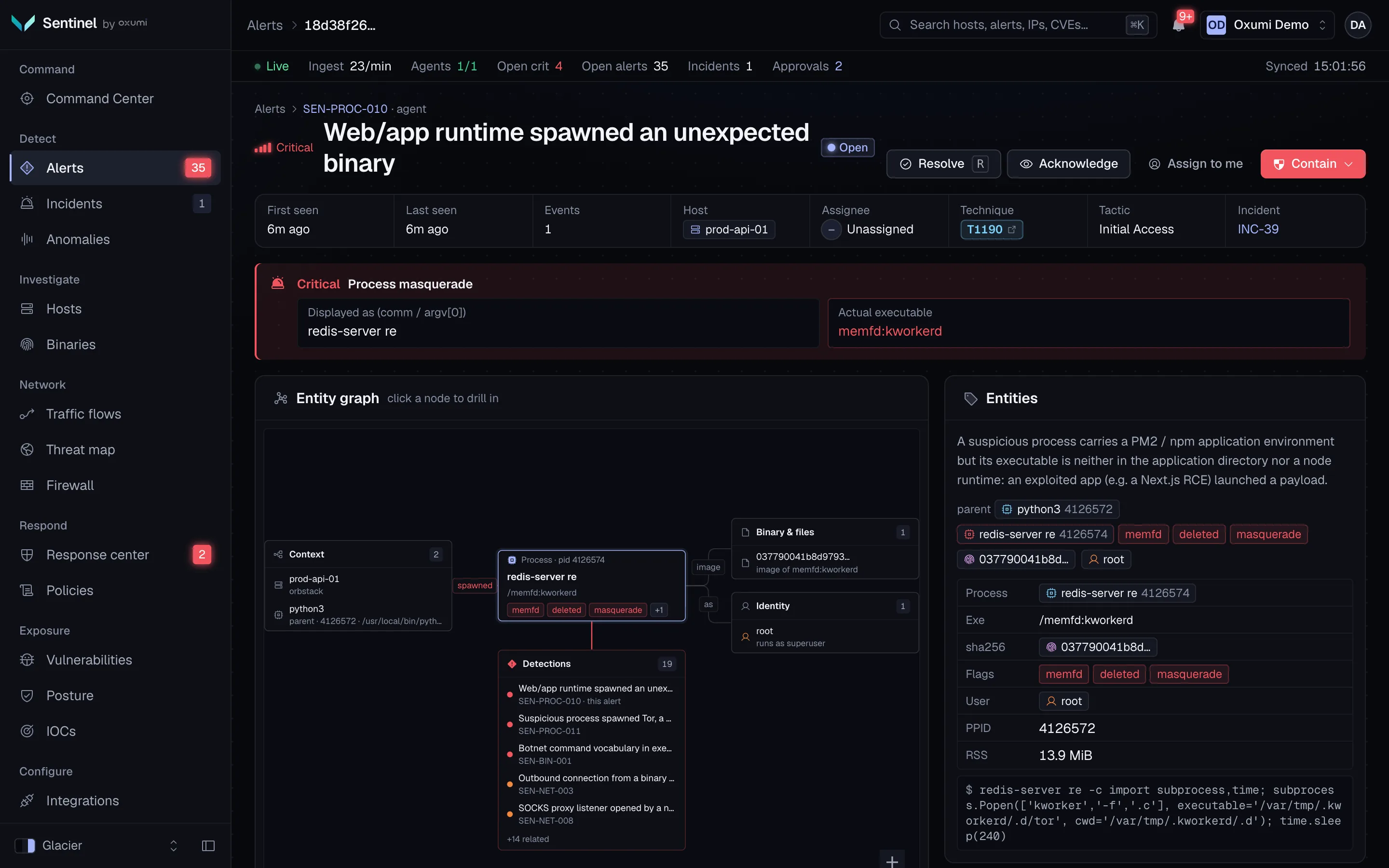
Every alert explains itself.
- 01
What fired, and why
The rule, its ATT&CK technique and the exact evidence that matched. - 02
Who, from where
Process, parent, user, file, connection and source IP, linked. - 03
What happened next
Related alerts fold into an incident with a timeline. - 04
What to do
Implant-class alerts carry an ordered containment playbook.
Put a sentinel on every Linux server.
One command to install, one dashboard to monitor, one workspace to understand what happened across your fleet.