Catch the Linux compromise.Every step of it.
Sentinel watches every process, connection, cron file and package on your Linux servers, explains what did what, maps it to MITRE ATT&CK, and contains it with signed, human-approved commands. Open source, self-hosted, no inbound ports.
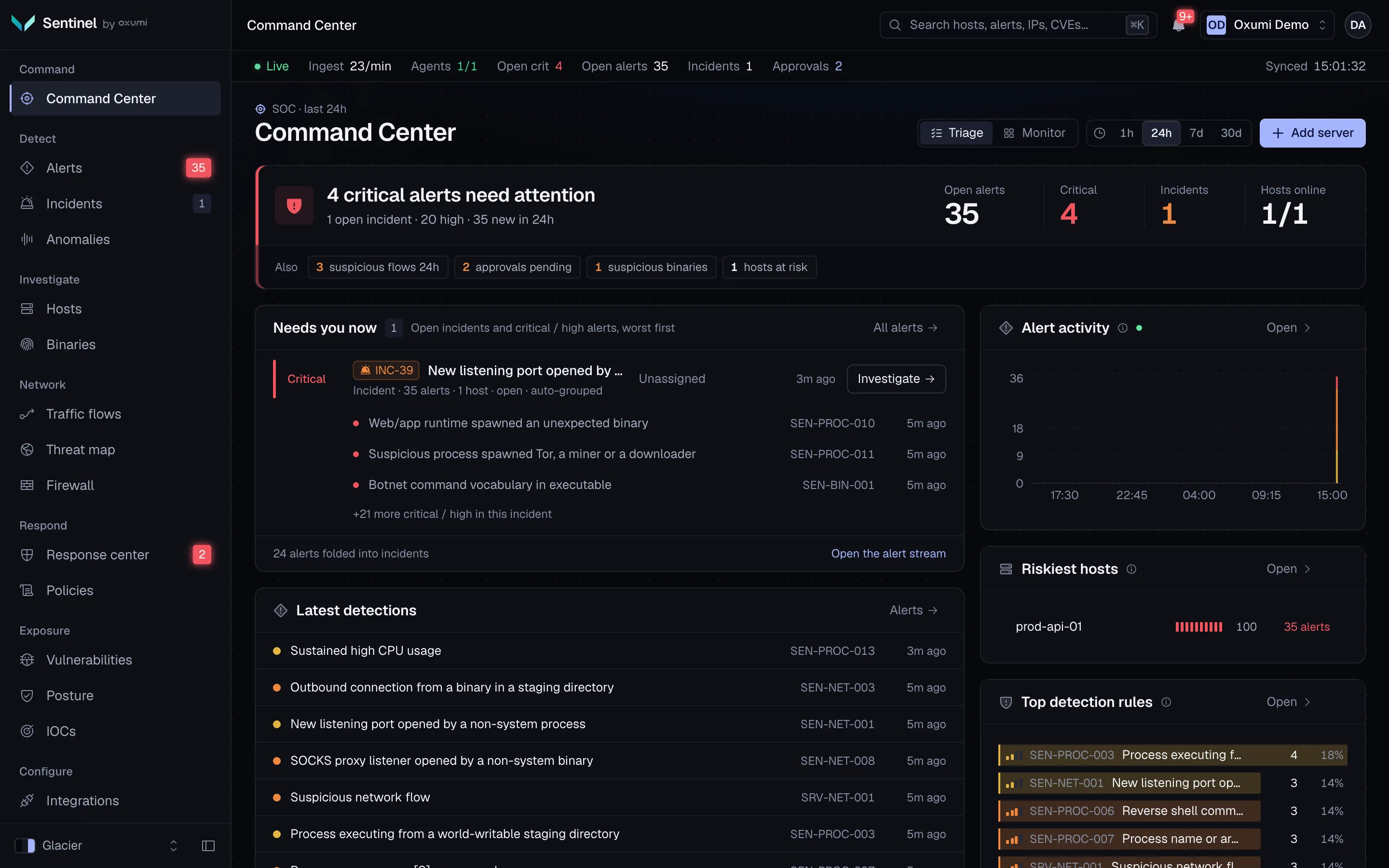
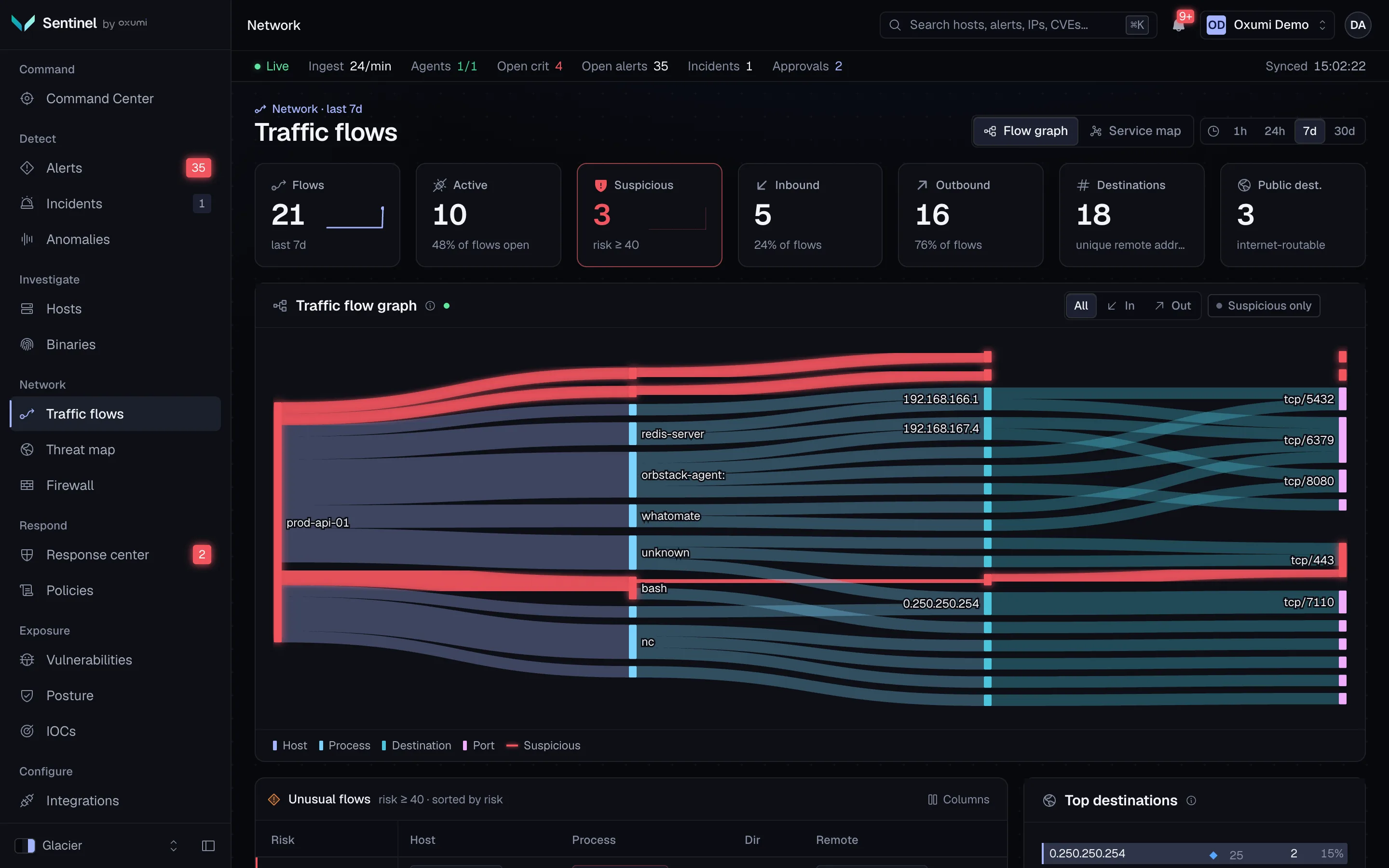
Command Center: one status line, then what needs you now, worst first.
Built on, and works with, what you already run
- Ubuntu22.04 · 24.04
- Debian12 · preview
- Dockeragent runtime
- nftablesfirewall
- MITRE ATT&CKrule mapping
- OSVvulnerabilities
- CISA KEVexploited CVEs
- Spamhaus · abuse.ch · Torthreat feeds
- DB-IPoffline geo / ASN
- Slackalerts
- WebhooksHMAC-signed
Catch implants, not just CVEs.
Process, network, auth, persistence and file collectors feed a rule engine that runs on the host itself, so detections survive a flaky network and never wait on the server.
- 01
41 rules, 24 ATT&CK techniques
Published, mapped and evaluated locally by the agent. Gaps are shown, not hidden. - 02
Implant-class signals
Masquerading as kworker, memfd and deleted binaries, hidden directories, PM2 environments where they don't belong. - 03
Binary analysis and IOCs
YARA-lite scans of suspicious executables and your own indicator lists, matched on every host. - 04
Learned baselines
Seasonal hour-of-week baselines flag sustained spikes and first-ever destinations, not one-off noise.
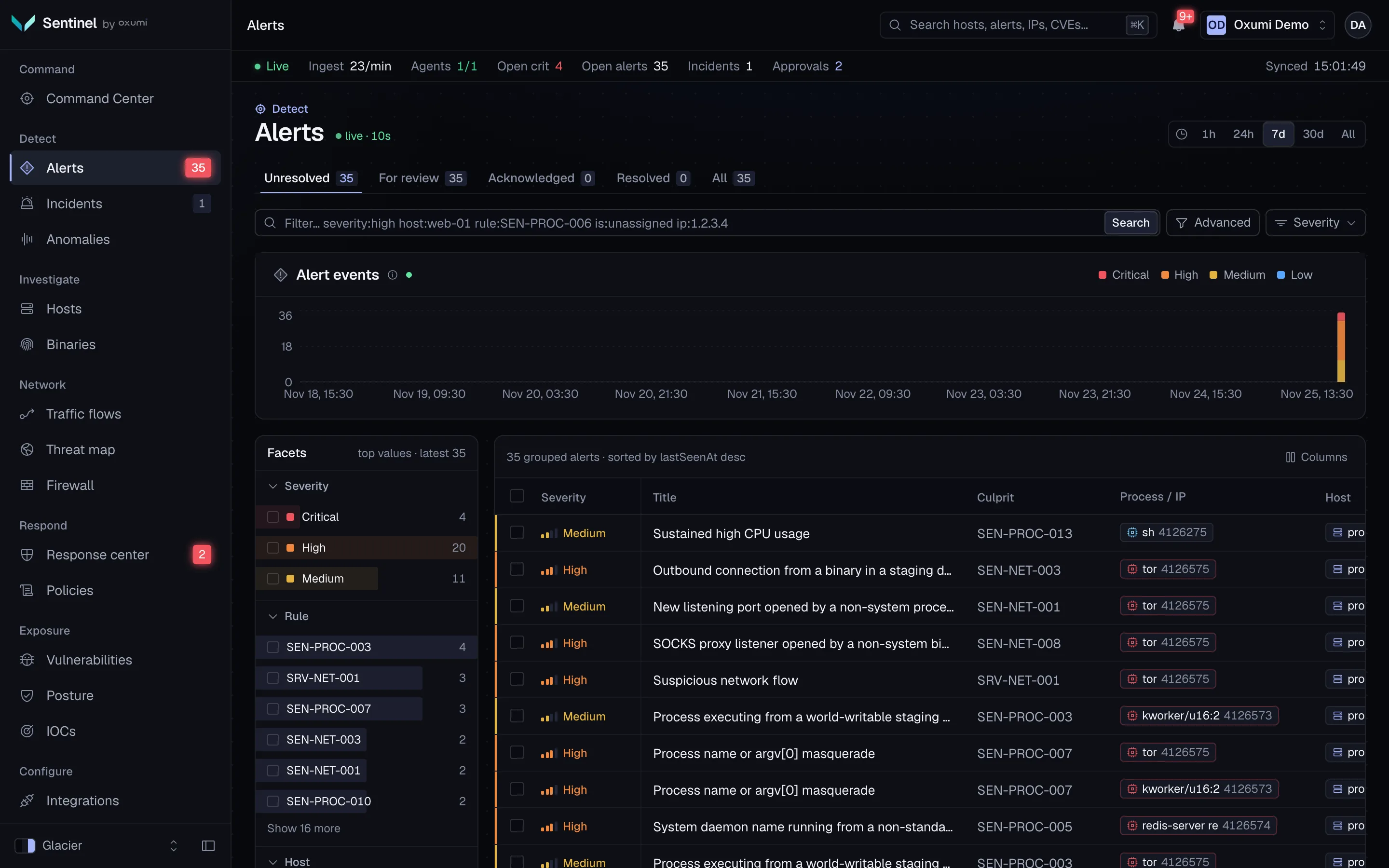
Rules that fired in a real replay
Web/app runtime spawned an unexpected binarycriticalSuspicious process spawned Tor, a miner or a downloadercriticalSOCKS proxy listener opened by a non-system binaryhighExplained, not just raised
Every alert carries its process, parent, connection, file and user, so “why?” is one click away.Severity mix of the built-in rules
critical3 ruleshigh24 rulesmedium14 rulesHonest about coverage
Rules are generated from the agent's own builtin.yaml, so this page never claims more than ships.Where detections run
Rule engineon the hostCorrelation into incidentscontrol planeInbound ports on the host0Works when the network doesn't
Events queue on disk and replay in order when the control plane is reachable again.
See what did what, and how you know.
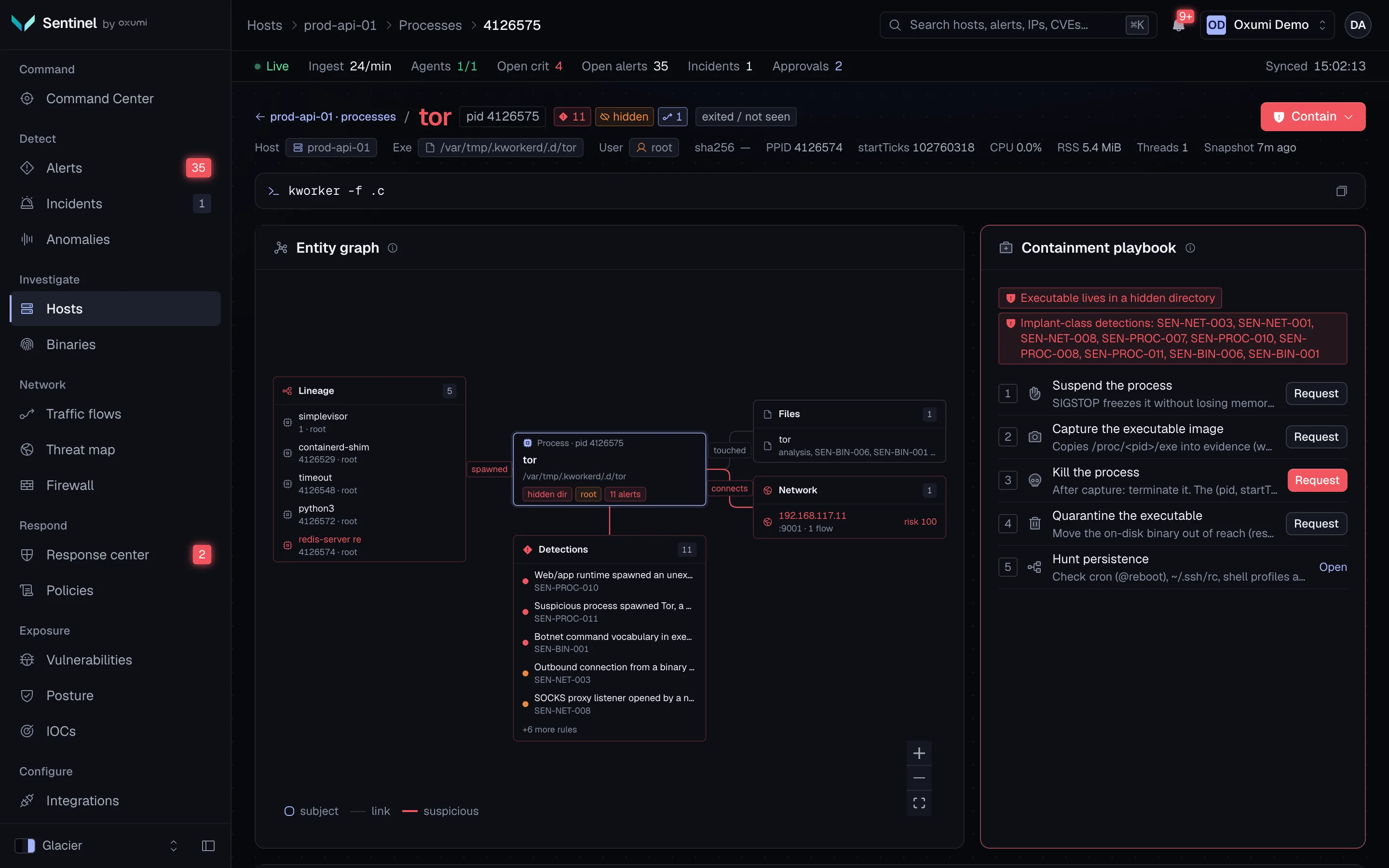
Alerts auto-correlate into incidents. Walk from an alert to the process, its parents, files, flows and the IPs behind them, without leaving the page.
- 01
Entity graph
Lineage, the subject, its children, files and remotes, grouped so it reads at a glance. - 02
Incidents, not alert storms
Related alerts on a host fold into one incident with a timeline and ATT&CK tactics observed. - 03
Process waterfall
Who started what, and when, from init to the payload. - 04
Forensic reports
Export a print-ready report with the evidence and the rule behind every step.
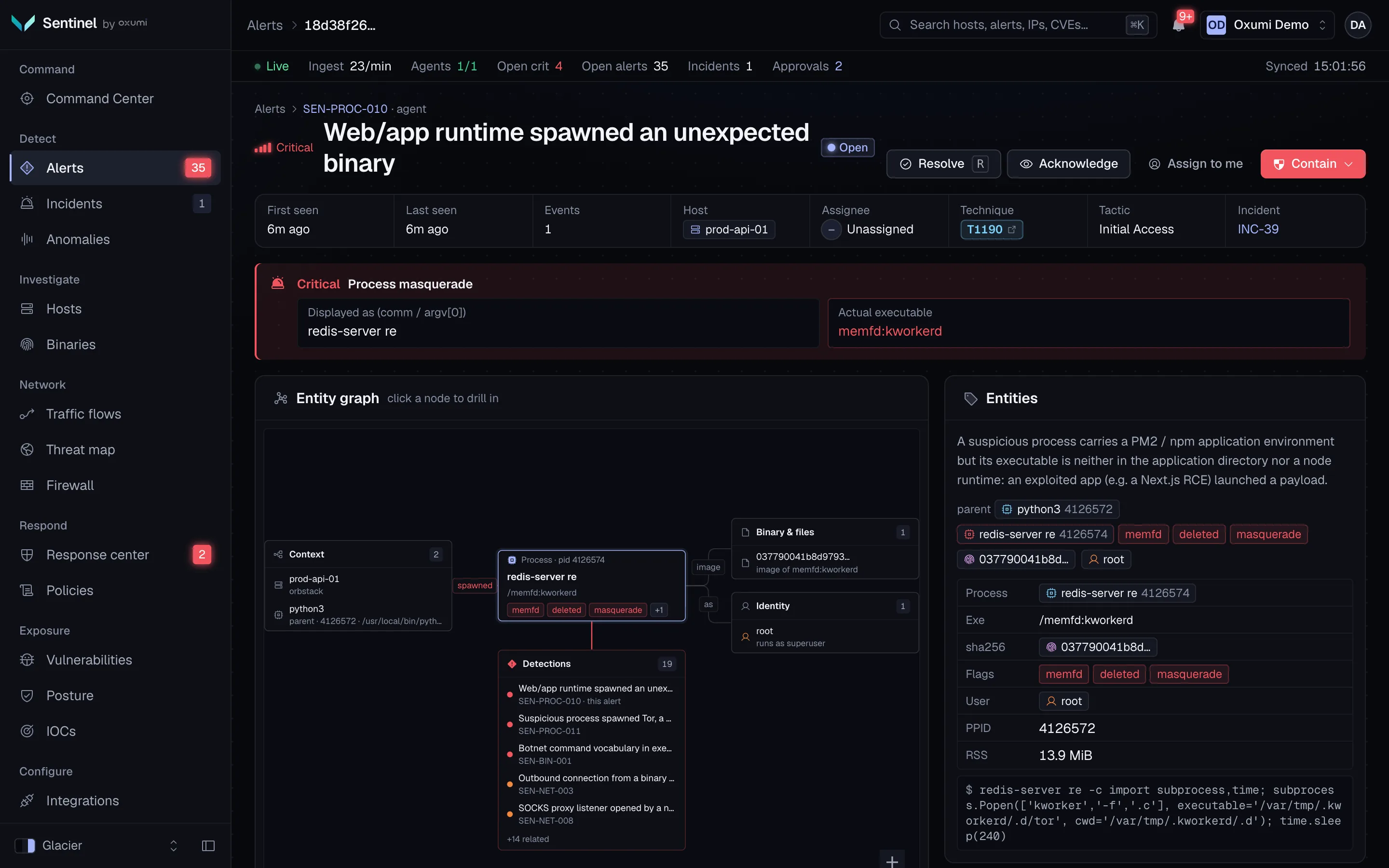
A kworker-masquerading implant, caught at every step.
The compromise that shaped Sentinel's implant-class detections, with the rule that fired at each step, through correlation and a two-person containment.
1T+00:00Initial access
The app runtime spawns a payload
SEN-PROC-010
2T+00:02Defense evasion
It hides in shared memory, dressed as a kernel thread
SEN-PROC-004SEN-PROC-009+2
3T+00:03Defense evasion
A fileless supervisor poses as redis-server
SEN-PROC-002SEN-PROC-005+2
4T+00:05Command and control
Tor launches from a hidden directory
SEN-PROC-011SEN-PROC-008+3
5T+00:09Command and control
It reaches out for command and control
SEN-NET-009SEN-NET-005+2
6T+00:14Persistence
It makes sure it survives a reboot
SEN-PERS-005SEN-PERS-003+1
7T+00:15Correlation
Sentinel connects the dots into one incident
8T+00:21Response
Contain it, with two people and a signature
Names, paths and rule ids are from the real incident; PIDs, addresses and timings are illustrative.
Contain in seconds, never by accident.
Human-approved, Ed25519-signed commands. The agent verifies every one before it suspends, captures, kills, blocks or isolates.
- 01
Two-person approval
A request names the action and the target. A second person approves. Both are audited. - 02
Signed, short-lived, host-bound
The control plane signs; the agent verifies signature, expiry and host before acting. - 03
A firewall you can see
A dedicated nftables table, SSH auto-ban and threat-feed blocking, never touching your own rules. - 04
Isolation with a dead-man switch
Isolation keeps the control plane reachable. If the agent loses it anyway, the isolation rolls itself back.
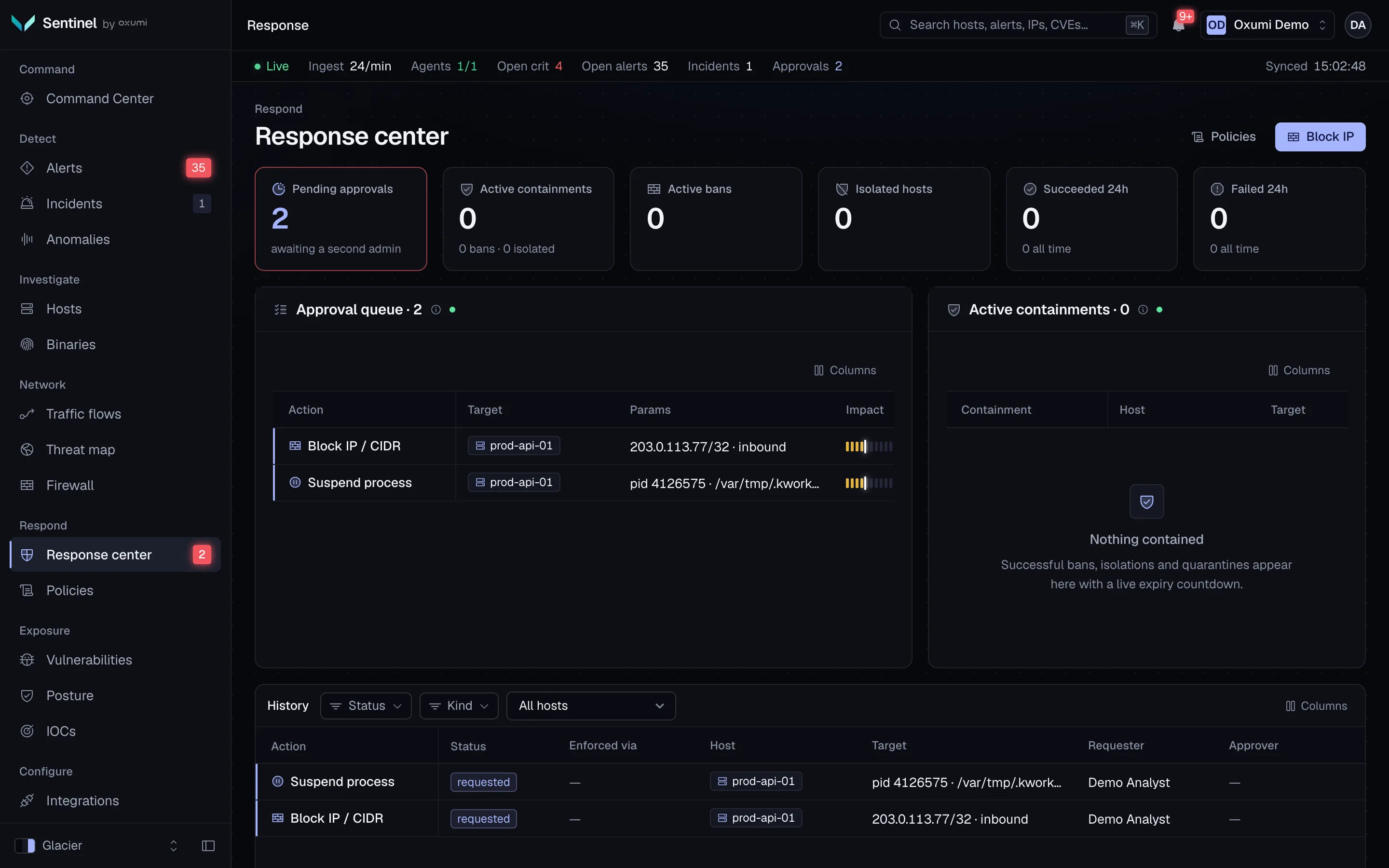
Fix what attackers actually exploit.
Distro-accurate vulnerability matching with OSV and CISA KEV, a CIS-style posture score and a live inventory of every host.
- 01
KEV first
Findings listed in CISA's Known Exploited Vulnerabilities catalog rise to the top. - 02
Distro-accurate
Matched with your distribution's own package versions through OSV, not a generic upstream list. - 03
Posture with remediation
CIS-style checks per host, each with what to change and why. - 04
Live inventory
Packages, users and SSH keys, listeners, cron jobs and containers, kept current by the agent.
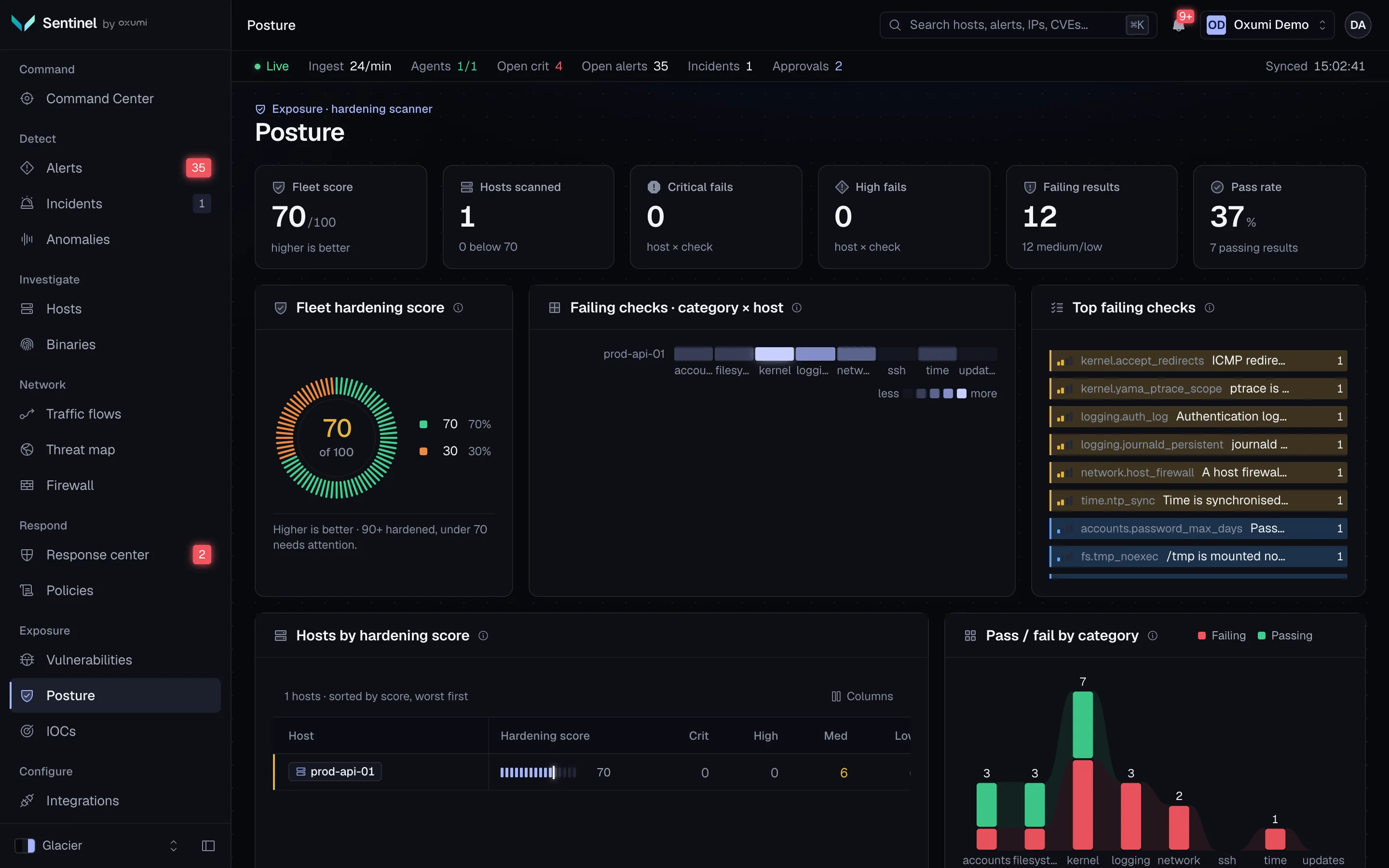
Your servers, your data, your control plane.
A static Go agent in a hardened, read-only container. It only ever dials out. Correlation, intel and approvals run on a control plane you host.
- built-in agent rules
- 41
- ATT&CK techniques mapped
- 24
- inbound ports on your hosts
- 0
- installer checks before any change
- 15
- signed requests and commands
- Ed25519
One command per server.
The installer checks the OS, kernel, runtime and control plane, pins the agent image by digest, verifies its signature and enrolls with a one-time token. Re-running it never creates a second host.
curl -fsSL https://install.oxumi.dev/sentinel.sh \ | sudo bash -s -- \ --server https://sentinel.example.com \ --token-file /root/sentinel.tokenThe hosted URL goes live with the first public release. Today, run installer/sentinel.sh from the repository with the same flags.
Put a sentinel on every Linux server.
One command to install, one dashboard to monitor, one workspace to understand what happened across your fleet.