Exposure
Fix what attackers actually exploit.
The agent inventories every package; the worker matches them against OSV and CISA's Known Exploited Vulnerabilities catalog, and scores each host's configuration against CIS-style checks.
Vulnerabilities
KEV first, noise last.
- 01
Distro-accurate
Matched against your distribution's own package versions through OSV, not a generic upstream list. - 02
Known exploited first
Findings in CISA KEV are flagged and ranked above everything else. - 03
Fix version shown
Installed and fixed versions side by side, per host. - 04
Air-gap friendly
Turn vulnerability intel off and the job simply idles; nothing else depends on it.
Vulnerabilities · fleetExample
| Vulnerability | Package | Installed → fixed | CVSS | KEV | Hosts |
|---|---|---|---|---|---|
CVE-2024-1086 High | linux-image-generic | 5.15.0.91.88 → 5.15.0.101.98 | 7.8 | KEV | 4 |
CVE-2023-4911 High | libc6 | 2.35-0ubuntu3.1 → 2.35-0ubuntu3.4 | 7.8 | KEV | 2 |
CVE-2024-6387 High | openssh-server | 1:8.9p1-3ubuntu0.6 → 1:8.9p1-3ubuntu0.10 | 8.1 | — | 3 |
CVE-2023-48795 Medium | openssh-client | 1:8.9p1-3ubuntu0.4 → 1:8.9p1-3ubuntu0.6 | 5.9 | — | 6 |
OSV + Ubuntu and Debian trackersCISA KEV, refreshed dailyDistro priority when there is no CVSS
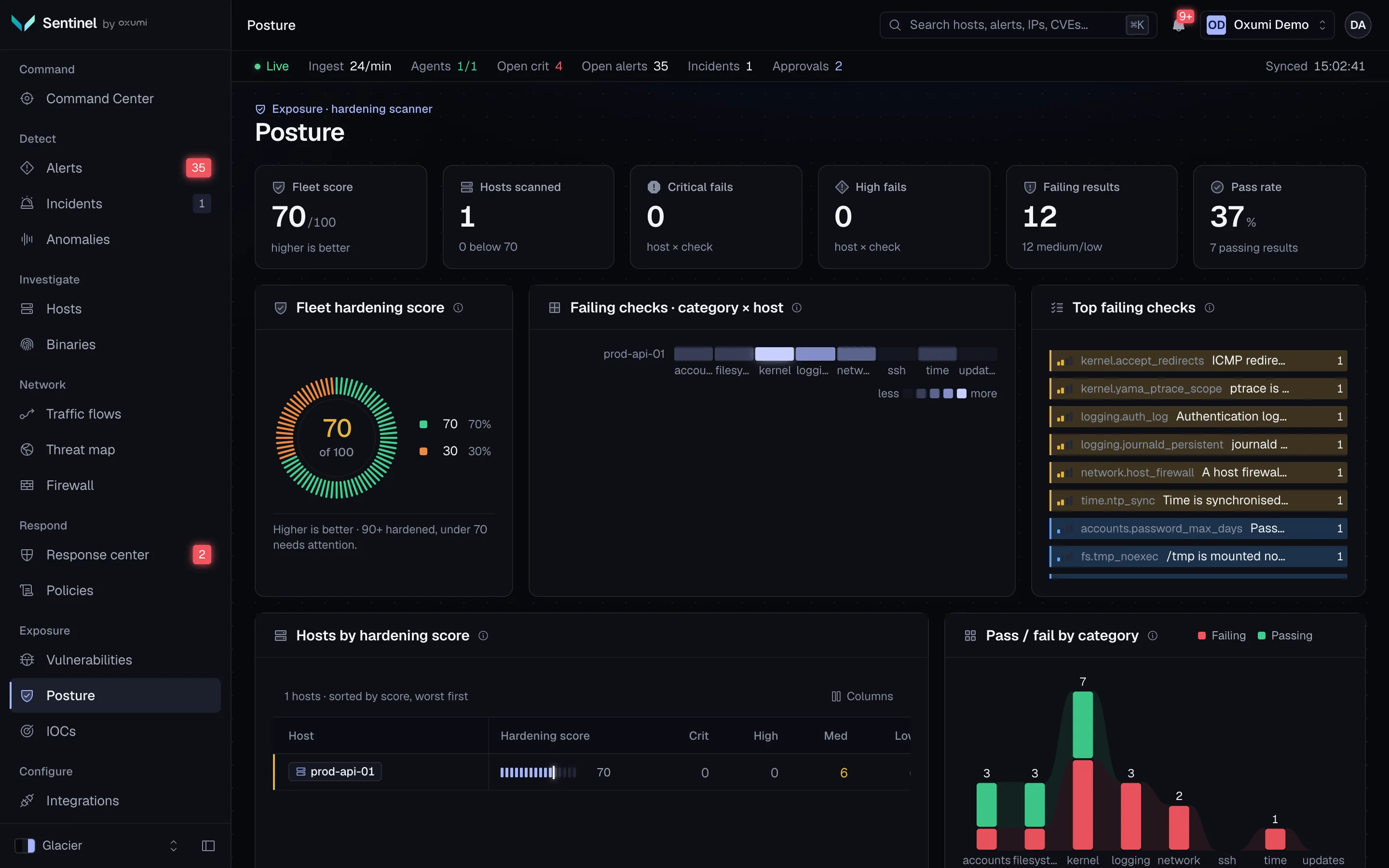
Posture
A posture score with the fix attached.
CIS-style checks run on every host: SSH hardening, account policy, unexpected SUID and world-writable files, kernel and network settings, and whether a host firewall is on. Each failing check says what to change and why.
Posture · app-01Example
0/ 100
Score = 100 − weighted fails
Critical 15 · high 8 · medium 4 · low 1
- PasswordAuthentication yes−8 · SSH
- net.ipv4.conf.all.accept_redirects = 1−4 · Kernel
- /tmp mounted without noexec−4 · Filesystem
- kernel.dmesg_restrict = 0−1 · Kernel
- PermitRootLogin noSSH
- kernel.randomize_va_space = 2Kernel
- No UID 0 besides rootAccounts
Inventory
Know what is on every host.
Kept current by the agent, so the answer to “which hosts run this?” is a search, not a ticket.
Packages
Name and version of every installed package, the input to vulnerability matching.Users & SSH keys
Local accounts, shells, locked state and authorized_keys fingerprints.Listeners
Every listening socket and the process that owns it.Scheduled jobs
Cron entries and their schedules, where persistence likes to hide.Containers
Containers on the host and the runtime they run under.SUID files
Set-uid binaries, with unexpected ones raised as a posture finding.
Put a sentinel on every Linux server.
One command to install, one dashboard to monitor, one workspace to understand what happened across your fleet.