A kworker-masquerading implant, caught at every step.
Scroll through the compromise that shaped Sentinel's implant-class detections: what the agent saw, the rule that fired at each step, the incident it became and a two-person containment.
Names, paths, techniques and rule ids are from the real incident and the agent's rules; PIDs, addresses and timings are illustrative.
T+00:00Initial access
The app runtime spawns a payload
A request exploits the Node.js app on the host. Its runtime launches a binary that lives outside the app directory and outside the node install, yet still carries the app's PM2 environment. That mismatch is the first thread to pull.
Evidenceprocess.start · env inspection (keys only, allowlisted values)- parent
- node next start (pid 1204, PM2 app)
- exe
- /dev/shm/.guard
- env
- PM2_HOME · pm_id=0 · NODE_ENV=production
- redacted
- +38 environment values
- SEN-PROC-010Web/app runtime spawned an unexpected binaryCriticalT1190
T+00:02Defense evasion
It hides in shared memory, dressed as a kernel thread
The payload detaches from the app (re-parented to PID 1) and renames itself kworker/u16:2. Real kernel threads have no executable on disk; this one runs from /dev/shm with a hidden file name, which the tmp scanner hashes and diffs every 60 seconds.
Evidenceprocess.snapshot · file.suspicious_executable- comm
- kworker/u16:2
- exe
- /dev/shm/.guard (ELF, +x, hidden name)
- ppid
- 1 re-parented to init, uid 1001
- sha256
- 9f2c4e…a81e1
T+00:03Defense evasion
A fileless supervisor poses as redis-server
Next, a supervisor starts from an anonymous memory file, so there is nothing on disk to find. Sentinel hashes the image through /proc/<pid>/exe (memfd and deleted images still work) and runs embedded YARA-lite rules over it.
Evidenceprocess.start · binary.analysis- comm
- redis-server
- exe
- /memfd:kworkerd (deleted)
- binary
- static · stripped · memfd_create + /proc/self/fd
- matches
- SEN-BIN-005 in-memory loader
T+00:05Command and control
Tor launches from a hidden directory
The supervisor drops Tor into a dot-directory under /var/tmp, runs it as "kworker -f .c" and opens a loopback SOCKS listener. A suspicious parent spawning Tor is the implant staging its next hop.
Evidenceprocess.start · network.listen · binary.analysis- exe
- /var/tmp/.kworkerd/.d/tor
- argv
- kworker -f .c
- listen
- 127.0.0.1:9151 (SOCKS)
- matches
- SEN-BIN-006 embedded Tor config (SocksPort, ClientOnly)
- SEN-PROC-011Suspicious process spawned Tor, a miner or a downloaderCriticalT1105
- SEN-PROC-008Executable inside a hidden directoryHighT1564.001
- SEN-PROC-007Process name or argv[0] masqueradeHighT1036.005
- SEN-NET-008SOCKS proxy listener opened by a non-system binaryHighT1090.003
- SEN-BIN-006Embedded Tor configurationHighT1090.003
T+00:09Command and control
It reaches out for command and control
Connections stuck in SYN_SENT are signal, not noise: failed C2 attempts. Tor relay connections follow on :9001. Server-side scoring adds up the reasons, and the flow crosses the suspicious line (≥ 40) on first sight.
Evidencenetwork.connection.open · flow scoring- SYN_SENT
- 198.51.100.23:443 ×6 in 30 s
- ESTAB
- 203.0.113.41:9001 tor relay
- reasons
- known-bad-port +50 · exe-in-tmp +40 · tor-relay +35
- risk
- 100 / 100 → SRV-NET-001 (high)
T+00:14Persistence
It makes sure it survives a reboot
Finally the implant writes an @reboot line into the user crontab. Sentinel diffs cron files, flags the at-reboot line at high severity, and the binary scan already showed this executable writes reboot entries itself.
Evidencepersistence watch · binary.analysis- file
- /var/spool/cron/crontabs/app
- + line
- @reboot /dev/shm/.guard >/dev/null 2>&1
- matches
- SEN-BIN-004 writes reboot cron entries
T+00:15Correlation
Sentinel connects the dots into one incident
Open alerts on the same host within 30 minutes are auto-correlated into a single incident, titled from the top rule and host, with the maximum severity, every ATT&CK technique, the process tree, flows and a timeline. Export it as a print-ready forensic report.
INC-0042AutoCriticalapp-01 · 30-min windowWeb/app runtime spawned an unexpected binary on app-01
21alerts11techniques3processesT1190T1036.004T1036T1105T1620T1036.005T1070.004T1564.001T1090.003T1071T1053.003- T+00:00The app runtime spawns a payload
- T+00:02It hides in shared memory, dressed as a kernel thread
- T+00:03A fileless supervisor poses as redis-server
- T+00:05Tor launches from a hidden directory
- T+00:09It reaches out for command and control
- T+00:14It makes sure it survives a reboot
Forensic report: markdown or print-ready HTMLT+00:21Response
Contain it, with two people and a signature
An analyst requests the playbook; a different admin approves each step. The control plane signs a short-lived command with Ed25519. The agent verifies the signature against its pinned key, its own host id, expiry, replay set and profile before it touches anything.
- 1suspend_processSIGSTOP the supervisor; memory preserved for forensicsrequested
- 2capture_process_imageCopy /proc/<pid>/exe to evidence/ with sha256queued
- 3block_ipDeny outbound to C2 and relay in inet oxumi_sentinelqueued
- 4kill_processpidfd + starttime verified, TERM → KILLqueued
requested by analystapproved by a second adminControl planesign Ed25519keyId k_01 · ttl 15mAgent · app-01- Ed25519 signature · pinned key
- agentId / hostId are this host
- now < expiresAt
- commandId not seen before
- kind allowed by profile "response"
- params valid (pid + startTicks + exe)
// command = base64url(payload) . base64url(sig)
{"v":1,"kind":"suspend_process","params":{"pid":3186369,"startTicks":41823651},"expiresAt":"…"}
- ◆systemdpid 1
- └─PM2 v5 God Daemonpid 811
- └─node next startpid 1204
- └─/dev/shm/.guardspawned
- parent
- node next start (pid 1204, PM2 app)
- exe
- /dev/shm/.guard
- env
- PM2_HOME · pm_id=0 · NODE_ENV=production
- redacted
- +38 environment values
- SEN-PROC-010Web/app runtime spawned an unexpected binaryCriticalT1190
The same attack, on a real Sentinel.
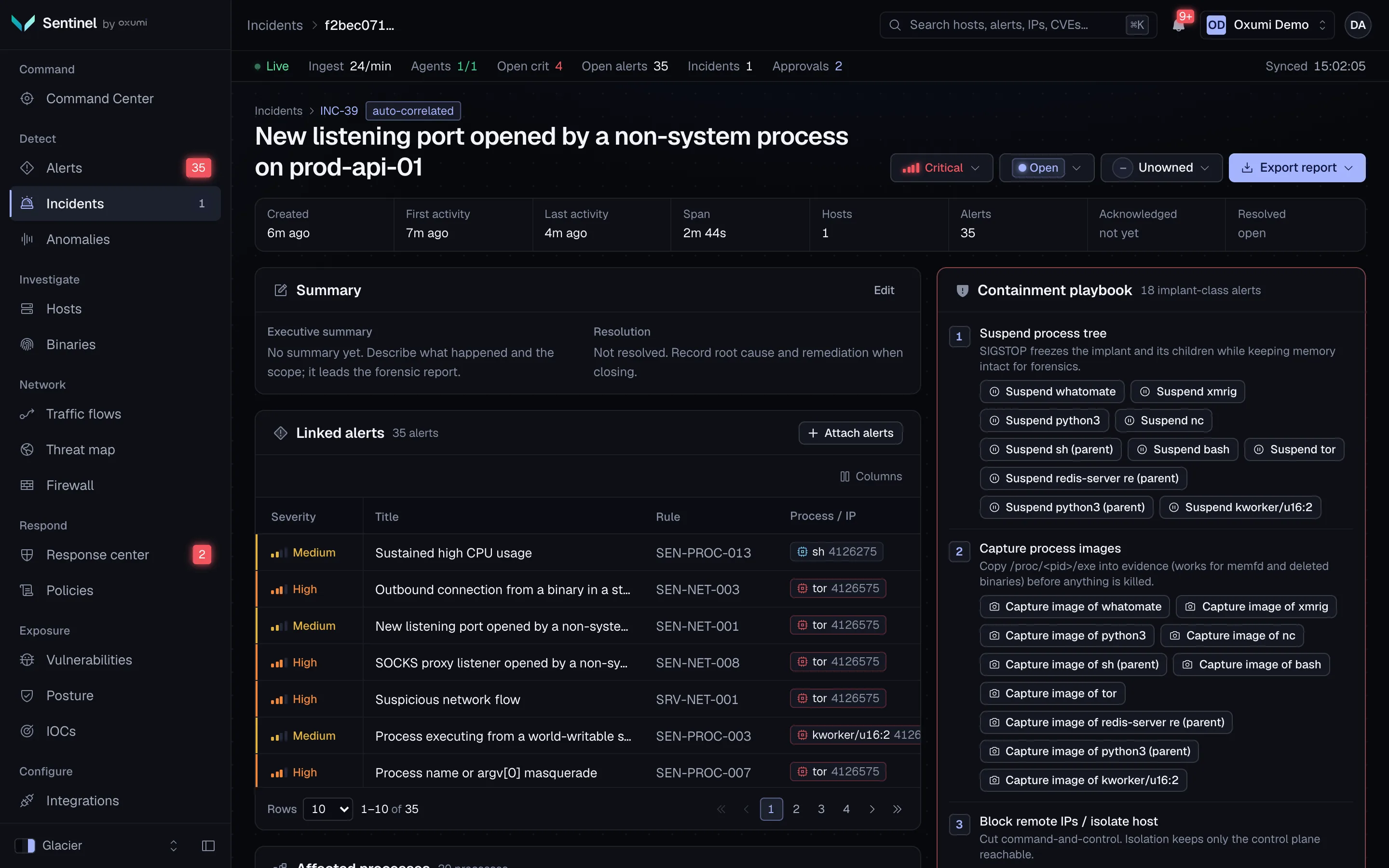
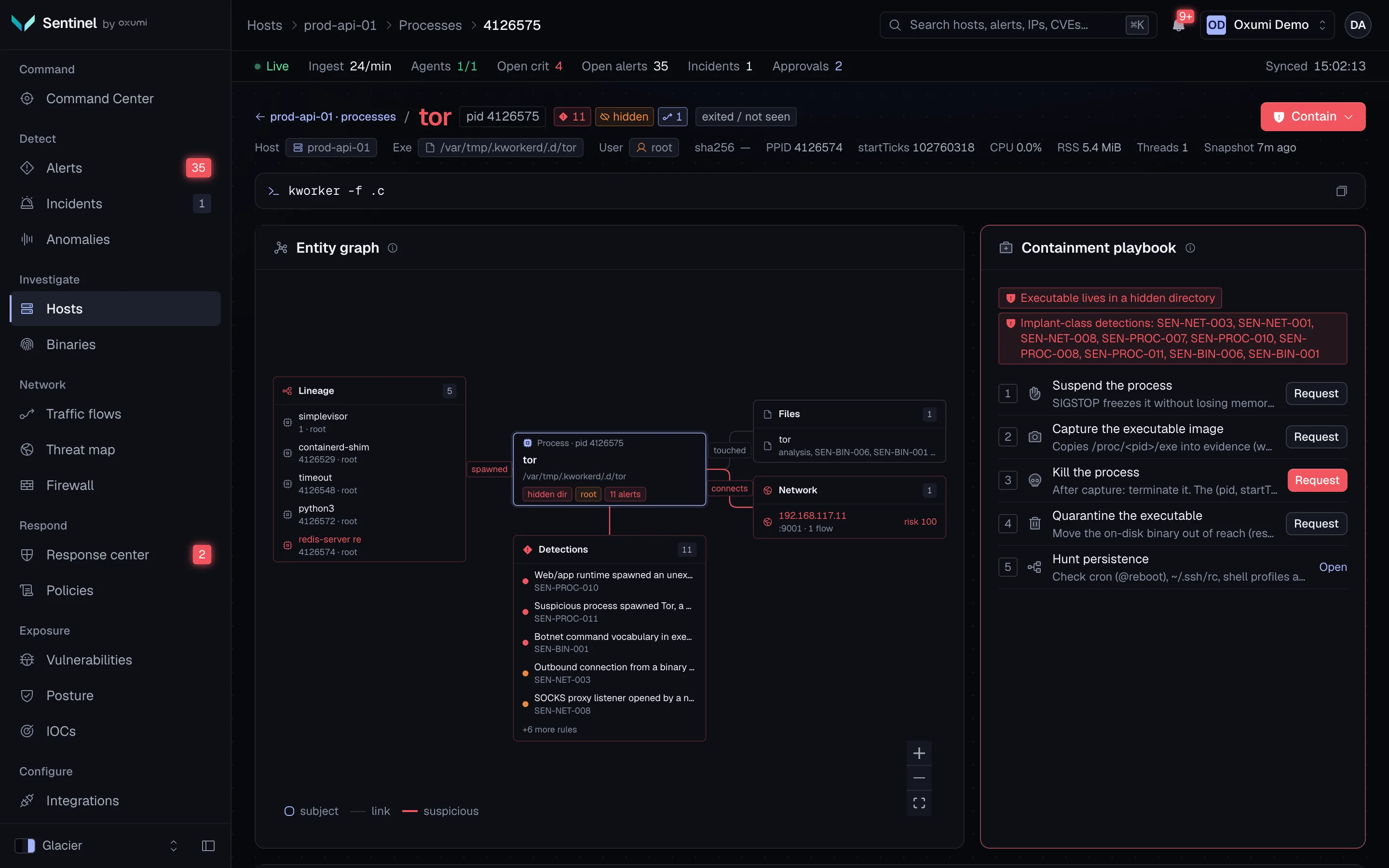
We ran the repository's harmless attack simulation, including this implant, on a test host with the agent installed. This is the incident Sentinel correlated from it, exactly as the API returned it.
35
alerts folded in
22
distinct rules fired
13
ATT&CK techniques
- 09:25:19New listening port opened by a non-system processSEN-NET-001 · command and controlMedium
- 09:25:19Executable staged in a temporary directorySEN-FILE-001 · command and controlMedium
- 09:25:54Process executing from a world-writable staging directorySEN-PROC-003 · command and controlMedium
- 09:25:54Cryptocurrency miner processSEN-PROC-012 · impactHigh
- 09:25:59Suspicious network flowSRV-NET-001 · command and controlHigh
- 09:25:59Connection to a cryptocurrency mining pool portSEN-NET-004 · impactHigh
- 09:25:59Outbound connection from a binary in a staging directorySEN-NET-003 · command and controlHigh
- 09:26:04Reverse shell command lineSEN-PROC-006 · executionHigh
- 09:26:09Shell or interpreter listening on all interfacesSEN-NET-006 · command and controlMedium
- 09:26:09Shell or netcat with a connection to a public IPSEN-NET-002 · executionHigh
- 09:26:14Botnet command vocabulary in executableSEN-BIN-001 · command and controlCritical
- 09:26:14Embedded Tor configurationSEN-BIN-006 · command and controlHigh
- 09:26:14Process running from a deleted binarySEN-PROC-001 · defense evasionHigh
- 09:26:14Suspicious process spawned Tor, a miner or a downloaderSEN-PROC-011 · command and controlCritical
- 09:26:14Fileless execution from memfdSEN-PROC-002 · defense evasionHigh
- 09:26:14Web/app runtime spawned an unexpected binarySEN-PROC-010 · initial accessCritical
- 09:26:14Process name or argv[0] masqueradeSEN-PROC-007 · defense evasionHigh
- 09:26:14Executable inside a hidden directorySEN-PROC-008 · defense evasionHigh
- 09:26:14Userland process masquerading as a kernel threadSEN-PROC-004 · defense evasionHigh
- 09:26:14System daemon name running from a non-standard pathSEN-PROC-005 · defense evasionHigh
- 09:26:19SOCKS proxy listener opened by a non-system binarySEN-NET-008 · command and controlHigh
- 09:28:04Sustained high CPU usageSEN-PROC-013 · impactMedium
- simplevisor1
- containerd-shim4126529
- timeout4126548
- python34126572
- redis-server re4126574
exe /memfd:kworkerd
- 100tor 192.168.117.11:9001known-bad-port, exe-in-tmp
- 100xmrig 192.168.117.5:3333known-bad-port, exe-in-tmp
- 90bash 104.20.23.154:443shell-network, first-seen-destination
- 25whatomate 192.168.167.2:6379first-seen-destination, rare-destination
- 25whatomate 192.168.167.1:33020first-seen-destination, rare-destination
Captured from a live Sentinel instance on 2026-11-25 while the repository's harmless attack simulation ran on a test host. Nothing on this card is edited.
Reproduce it, harmlessly.
The simulation runs in disposable, locked-down containers (no capabilities, read-only root, memory and pid limits) on a private network. Payloads are copies of sleep, python, perl and busybox; nothing malicious is contacted.
| Scenario | What it does | Expected rules |
|---|---|---|
| kworker-implant | The shape of the 2026-11-23 incident: a memfd supervisor posing as redis-server, a kworker-named guard and a Tor child in a hidden directory | |
| xmrig-pool | A /tmp binary named xmrig connected to a local listener on :3333 | |
| shell-socket | bash holding /dev/tcp to a local nc listener | |
| python-listener | A python one-liner listening on 0.0.0.0:8765 | |
| tmp-exec | A copy of sleep run from /tmp | |
| ssh-bruteforce | 12 failed logins from 203.0.113.77 (TEST-NET-3) in a test log | |
| cpu-burn | A niced busy loop on one CPU for 180 s | |
| shell-public | bash with a TCP socket to www.example.com:443 that sends nothing |
# all scenarios, detached (~4 min)scripts/simulate/simulate.sh# only the implant from this pagescripts/simulate/simulate.sh --only kworker-implant# fully offline: skip the two public-network scenariosscripts/simulate/simulate.sh --skip curl-public,shell-public# remove every sentinel-sim-* object nowscripts/simulate/simulate.sh --cleanupPut a sentinel on every Linux server.
One command to install, one dashboard to monitor, one workspace to understand what happened across your fleet.